
Langfuse Observability
Astron Agent can export its existing OpenTelemetry traces to Langfuse through a raw OTLP/HTTP bridge. The bridge does not require the Langfuse Python SDK. It preserves Astron's workflow and agent span hierarchy while adding the semantic attributes Langfuse uses for generations, tools, token usage, latency, and trace filtering.
The transport and attribute mapping follow Langfuse's v4 custom-ingestion checklist and its documented observation types.
Langfuse export is disabled by default. Enabling it sends telemetry to the configured Langfuse deployment, so review the privacy settings before using production traffic.
Supported versions
- Langfuse v4.x is supported; self-hosted Langfuse v4.6.0 is verified end to end.
- Langfuse v3 is not claimed because this bridge uses the v4 observations-first attribute model and ingestion header without a v3 test matrix. Langfuse v2 is not supported.
- Astron requires Python 3.11 or newer. Workflow is locked to OpenTelemetry 1.25.x; Agent and the shared bridge are tested with 1.27.x and constrain OpenTelemetry packages to the supported pre-2.0 range.
- The only supported Langfuse transport is OTLP over HTTP/protobuf; OTLP/gRPC is not supported by this integration.
How the bridge works
- Workflow and agent services keep using their existing OpenTelemetry tracer providers and nested spans.
- Langfuse uses a dedicated batched OTLP/HTTP exporter. The exporter runs in parallel with Astron's existing OTLP exporter and local span logging.
OTLP_ENABLEcontinues to control the existing general-purpose OTLP path.LANGFUSE_ENABLEDcontrols the Langfuse path independently.- Astron derives the Langfuse v4-compatible traces endpoint from
LANGFUSE_HOSTas<LANGFUSE_HOST>/api/public/otel/v1/traces. Configure the deployment base URL, not the full OTLP endpoint. - Astron authenticates the generated request in memory with the Langfuse project public and secret keys. Credentials are not added to span attributes.
- Workflow-to-agent and nested-workflow calls propagate the standard W3C
traceparent/tracestatecontext only when Langfuse is enabled. Astron authenticates the exact internal carrier with a separate Astron-only secret. The short-lived HMAC is bound to the HTTP method, destination service/path, tenant identity, and timestamp. Unsigned, expired, replayed against another endpoint or tenant, or modified public headers start a new local trace and cannot provide trace-wide Langfuse fields. Signed propagation headers are removed from span events and node logs. - Langfuse is effectively enabled only when the flag is true, both project keys are present, and the host and environment values are valid. Otherwise the integration is inert: it does not add Langfuse/GenAI attributes or baggage, alter provider request bodies or streaming frames, propagate remote parentage, rename existing spans, or add Langfuse-only child spans to the normal OTLP/file pipelines.
If both exporters are enabled, one execution can therefore be sent to both your existing collector and Langfuse. Do not point both exporter paths at the same Langfuse project unless duplicate delivery is intentional.
Configuration
The same settings apply to the workflow and agent services.
| Variable | Default | Description |
|---|---|---|
LANGFUSE_ENABLED | false | Enables the independent Langfuse exporter. |
LANGFUSE_PUBLIC_KEY | empty | Langfuse project public key. Required when enabled. |
LANGFUSE_SECRET_KEY | empty | Langfuse project secret key. Required when enabled. |
ASTRON_TRACE_CONTEXT_SECRET | empty | Independent Astron-only secret shared by Agent and Workflow. Recommended to preserve trusted trace continuity across services. |
LANGFUSE_HOST | https://cloud.langfuse.com | Cloud or self-hosted Langfuse base URL. |
LANGFUSE_CAPTURE_INPUT_OUTPUT | false | Allows prompt/input and response/output content to leave Astron. |
LANGFUSE_MAX_ATTRIBUTE_LENGTH | 8192 | Maximum length of an exported string attribute. |
LANGFUSE_ENVIRONMENT | default | Lowercase environment label ([a-z0-9_-], at most 40 characters, and not starting with langfuse). Invalid values disable the exporter. |
LANGFUSE_RELEASE | empty | Optional application release or deployment label. |
Both project keys must be configured before export can be enabled. Generate a separate strong random value for ASTRON_TRACE_CONTEXT_SECRET and inject the same value into Agent and Workflow. It is used only for internal trace-context authentication, can be rotated independently from the Langfuse credentials, and is never sent to Langfuse. Treat both secrets like production credentials: inject them at runtime with a secret manager and never put them in source control, screenshots, or command logs. If the Astron-only secret is omitted, local export still works, but cross-service trace context is not trusted or continued.
Docker Compose
Create the local deployment environment file and set project-specific values:
cd docker/astronAgent
cp .env.example .envLANGFUSE_ENABLED=true
LANGFUSE_PUBLIC_KEY=pk-lf-your-project
LANGFUSE_SECRET_KEY=sk-lf-your-project
ASTRON_TRACE_CONTEXT_SECRET=replace-with-a-separate-random-secret
LANGFUSE_HOST=https://cloud.langfuse.com
LANGFUSE_CAPTURE_INPUT_OUTPUT=false
LANGFUSE_MAX_ATTRIBUTE_LENGTH=8192
LANGFUSE_ENVIRONMENT=development
LANGFUSE_RELEASE=local-observability-demoStart the normal Astron deployment, or recreate the two already-running services so they receive the changed environment:
docker compose up -d
# For an existing deployment:
docker compose up -d --force-recreate core-workflow core-agent
The Compose file passes all settings to both services. For a self-hosted Langfuse instance on the same Docker network, use its service name, for example http://langfuse-web:3000. localhost inside an Astron container refers to that container, not to the Docker host.
Source and Helm deployments
For a source deployment, export the variables in the service environment or set them in both core/workflow/config.env and core/agent/config.env. Restart both services after a configuration change.
For Helm, first create a Kubernetes Secret from credential files or through your normal ExternalSecret/GitOps mechanism. The default key names are public-key, secret-key, and trace-context-secret; credential values never belong in Helm values:
ASTRON_NAMESPACE=astron-agent
LANGFUSE_SECRET_NAME=astron-langfuse
kubectl create namespace "$ASTRON_NAMESPACE" --dry-run=client -o yaml | kubectl apply -f -
kubectl --namespace "$ASTRON_NAMESPACE" create secret generic "$LANGFUSE_SECRET_NAME" \
  --from-file=public-key=/secure/path/langfuse-public-key \
  --from-file=secret-key=/secure/path/langfuse-secret-key \
  --from-file=trace-context-secret=/secure/path/astron-trace-context-secret \
  --dry-run=client -o yaml | kubectl apply -f -

helm upgrade --install astron-agent ./helm/astron-agent \
  --namespace "$ASTRON_NAMESPACE" --create-namespace \
  --set langfuse.enabled=true \
  --set-string langfuse.existingSecret.name="$LANGFUSE_SECRET_NAME" \
  --set-string langfuse.environment=staging
The command above is a first-install example. For an existing release, merge the langfuse block into its controlled values file and pass the complete release values during helm upgrade; a short list of --set flags does not preserve unrelated custom values. The template also tolerates legacy releases whose reused values do not yet contain a langfuse map.
The chart injects the same non-secret settings and Secret references into only the Agent and Workflow deployments. Enabling Langfuse without an existing Secret name fails during template rendering. For a Secret that uses different data keys, set langfuse.existingSecret.publicKeyKey and langfuse.existingSecret.secretKeyKey; use langfuse.existingSecret.traceContextSecretKey for the independent internal secret. That key is optional for backward-compatible upgrades; when absent, each service still exports its local spans but does not trust cross-service trace context. If Secret data is rotated without another values change, restart those two deployments so their environment is refreshed.
Privacy defaults
With LANGFUSE_CAPTURE_INPUT_OUTPUT=false, the Langfuse exporter retains structural telemetry such as span names, parent-child relationships, status, latency, node and tool identity, model identity, and token counts. Before a span leaves the process, it also:
- removes legacy span events, because existing events can contain complete workflow definitions, prompts, model responses, request bodies, or tool results;
- removes known payload-bearing or sensitive input/output attributes; and
- truncates retained string attributes to
LANGFUSE_MAX_ATTRIBUTE_LENGTH.
Server-derived langfuse.user.id and langfuse.session.id values remain available for trace correlation even when content capture is off. Use pseudonymous identifiers, or leave Langfuse disabled, when deployment policy does not allow those identifiers to leave Astron.
Consequently, the default Langfuse trace can be used for execution topology, errors, latency, and usage analysis without exporting raw prompt or response content. This is a data-minimization boundary, not a substitute for checking your own node labels, model identifiers, tenant metadata, and deployment policies.
Set LANGFUSE_CAPTURE_INPUT_OUTPUT=true only for synthetic, de-identified, or otherwise approved data. This setting is also required when a Langfuse evaluator needs a selected observation's input and output. Authentication credentials must never be placed in workflow inputs, prompts, labels, or test payloads regardless of this setting.
Generate a trace
- Configure Langfuse and start Astron.
- In the Astron UI, import a workflow containing at least an LLM node. A workflow with a tool, retrieval, or agent node produces a more useful nested trace.
- Note the imported flow ID and the test application's ID.
- Send a synthetic request through the real debug route:
The debug route is internal-only. For Docker Compose, load the automatically generated key from the running Workflow container into the current shell. For source or Helm deployments, load the same key from the configured environment or Secret instead; it does not need to be copied into .env.
DEMO_FLOW_ID="<imported-flow-id>"
DEMO_APP_ID="<test-application-id>"
DEMO_WORKFLOW_INTERNAL_KEY="$(
  docker compose exec -T core-workflow \
    sh -c 'tr -d "\r\n" < "$WORKFLOW_INTERNAL_API_KEY_FILE"'
)"

curl --no-buffer \
  --header "Content-Type: application/json" \
  --header "x-consumer-username: ${DEMO_APP_ID}" \
  --header "X-Workflow-Internal-Key: ${DEMO_WORKFLOW_INTERNAL_KEY}" \
  --data "{\"flow_id\":\"${DEMO_FLOW_ID}\",\"uid\":\"langfuse-demo-user\",\"chat_id\":\"langfuse-demo-1\",\"stream\":true,\"parameters\":{\"AGENT_USER_INPUT\":\"Synthetic request: summarize why tracing helps debugging.\"},\"ext\":{},\"history\":[]}" \
  http://127.0.0.1:7880/workflow/v1/debug/chat/completions
Replace AGENT_USER_INPUT if the imported workflow declares a different input variable. Use only synthetic content in a reproducibility artifact.
After the batch exporter flushes, open the Langfuse project and filter by LANGFUSE_ENVIRONMENT or LANGFUSE_RELEASE. Depending on the imported workflow, a representative trace contains:
/workflow/v1/debug/chat/completions       (HTTP transport span; physical root)
└── chat_debug                           (route span; `chat_open` in release mode)
    └── workflow.run                     (chain; evaluator input/output)
        └── engine_async_run
            ├── workflow.node:<llm-name>  (chain)
            │   └── llm.generate:<model> (generation, model, tokens, TTFT)
            ├── workflow.node:<tool-name> (tool)
            ├── workflow.node:<retriever> (retriever)
            └── workflow.node:<agent-name> (agent)
                └── agent.run             (same W3C trace)
                    ├── MakingStep         (generation)
                    ├── RunPlugin          (tool)
                    └── RunWorkflowPlugin  (nested workflow handoff)
An agent node can add nested model steps, reasoning steps, retrieval, MCP, plugin, and workflow-tool observations. Langfuse can calculate cost when the exported model identifier matches a model with pricing configured in Langfuse and the provider returns token usage.
Verified end-to-end result
The following redacted screenshot was generated with this bridge against a local, loopback-only Langfuse v4.6.0 deployment and synthetic data. The trace was exported through the production add_langfuse_span_processor path and contains 11 observations across CHAIN, AGENT, GENERATION, RETRIEVER, and TOOL types. Langfuse attributed 29 tokens and $0.000255 to the two generations, and an API-ingested observability-e2e score of 1.00 demonstrates the evaluation feedback path.
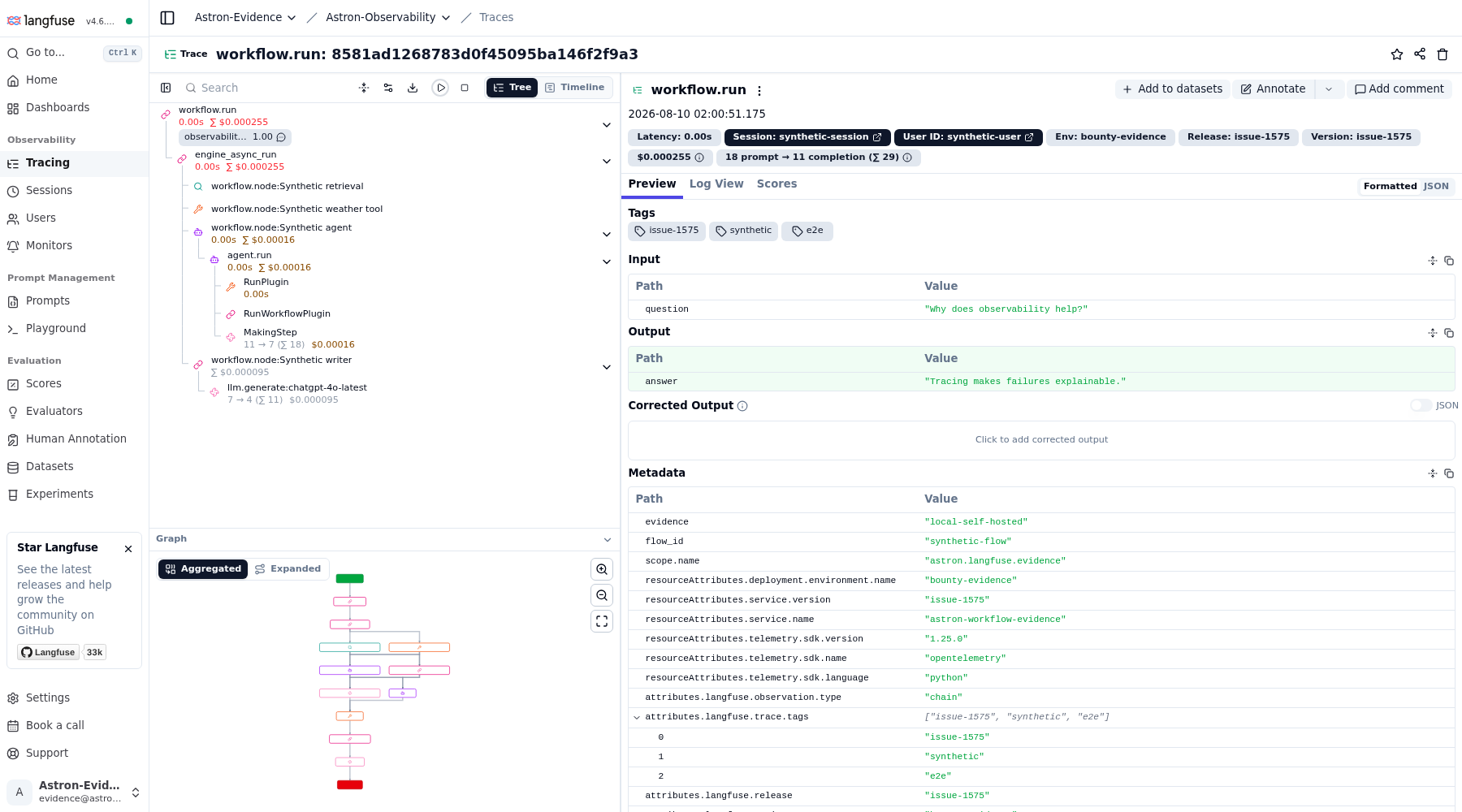
Input/output capture was enabled only for this synthetic evidence run. With the default LANGFUSE_CAPTURE_INPUT_OUTPUT=false, the same topology, usage, latency, and cost remain visible while the green input/output payload panels are omitted.
Verified managed LLM-as-a-judge result
A second synthetic run exercised real OpenAI-compatible model calls for both the application generation and an explicit judge observation. Trace f59a874fd9ceb00f6e9a384438bb9e04 contains 10 Astron observations across CHAIN, AGENT, GENERATION, RETRIEVER, TOOL, and EVALUATOR types. The application generation reported 75 input and 471 output tokens, while the explicit judge reported 613 input and 97 output tokens (1,256 in the trace).
A live Langfuse evaluator targeting the workflow.run observation independently wrote astron-root-answer-relevance-live: 1 with source EVAL. The separately ingested llm-judge-answer-relevance: 1 score confirms the documented trace-level API feedback path. Both scores appear on the same trace view, alongside the complete parent/child hierarchy, in the screenshot below. The run used only synthetic content on a loopback-only Langfuse v4.6.0 deployment; provider credentials, endpoints, and concrete model configuration are not included in the trace evidence or repository.
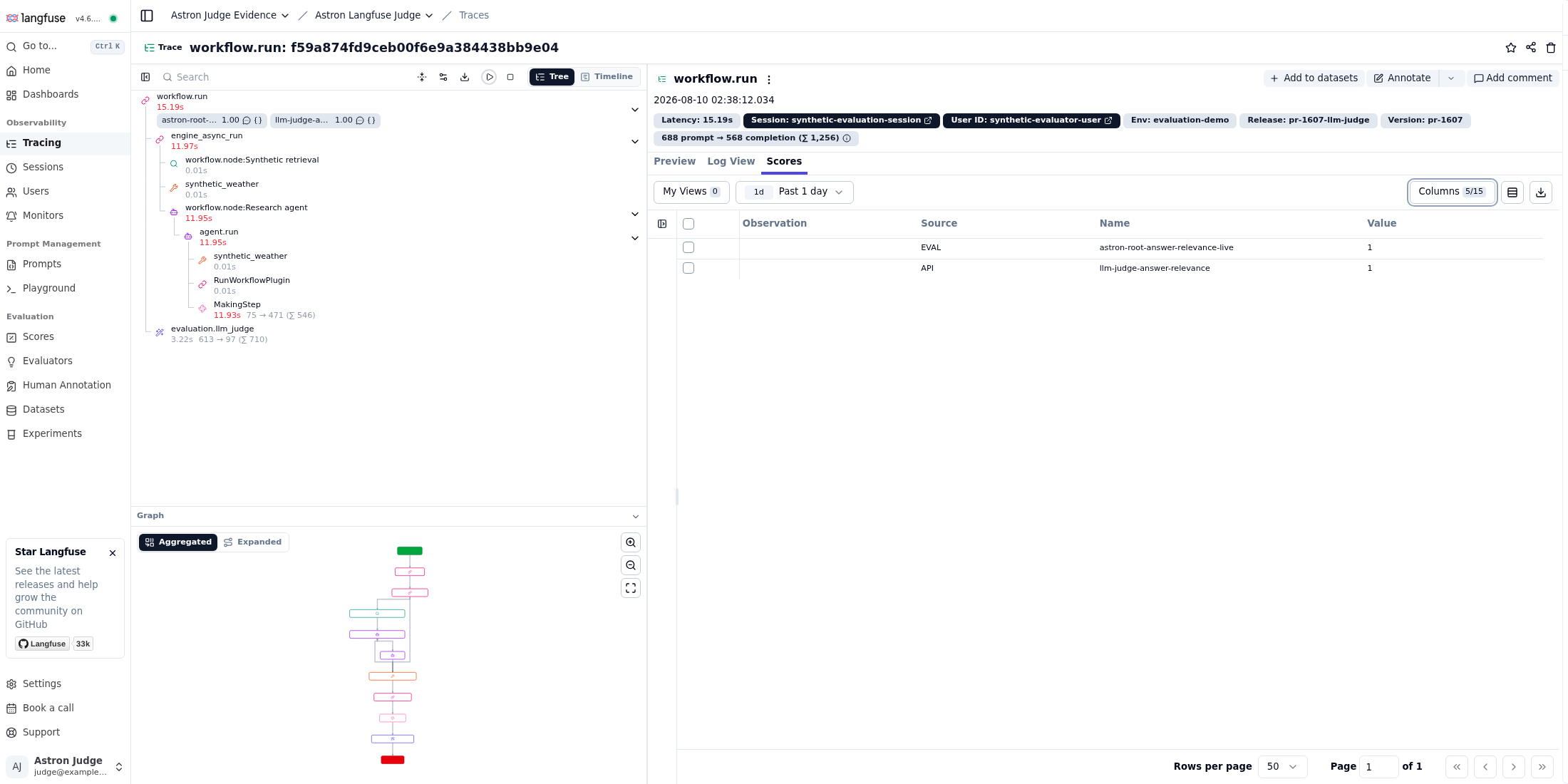
For a reproducible bug report or pull request, include the exact startup and request commands, the selected environment/release, and a redacted screenshot showing the trace hierarchy, model, tokens, and latency. Never include project keys or real user content.
Configure a Langfuse evaluator
Content-based evaluators need an input and output to evaluate. Astron's privacy default deliberately omits those fields from content-bearing observations.
- Use a dedicated non-production environment and synthetic or approved data.
- Set
LANGFUSE_CAPTURE_INPUT_OUTPUT=truefor both services and restart them. - Generate a new trace; changing the flag cannot restore content to an older trace.
- Confirm in Langfuse that the
workflow.runobservation contains the expected input and output. The HTTP request span is the physical root and intentionally has no content payload. - In Langfuse, create an evaluator for live observations, add an exact observation-name filter for
workflow.run, scope it further with the environment/release or a trace filter, and map that observation's input and output into the evaluator prompt. Langfuse evaluators target observations by name and type; see the official trace best practices. - Test the evaluator on one trace before enabling continuous execution. Check that its score appears on the same trace.
- Restore
LANGFUSE_CAPTURE_INPUT_OUTPUT=falsewhen content evaluation is no longer required.
For a direct Agent-service evaluation, use the same approach with the stable agent.run observation name. An evaluator can instead target a specific generation, retriever, or tool observation if that is the intended boundary. Keep its filter narrow so workflow bookkeeping spans are not evaluated as model outputs.
Reproduce the score feedback path
Langfuse evaluators write their result back as a score. To verify the same feedback path independently, attach a numeric score to a synthetic trace with the official Scores API. The following example reads credentials from the environment, builds the Basic authentication header in memory, and never places either key in a command-line argument:
export LANGFUSE_TRACE_ID="<synthetic-trace-id>"
python - <<'PY'
import base64
import json
import os
import urllib.request
from urllib.parse import urlsplit

host = os.environ.get("LANGFUSE_HOST", "https://cloud.langfuse.com").rstrip("/")
parts = urlsplit(host)
if parts.scheme not in {"http", "https"} or not parts.netloc or parts.username:
    raise SystemExit("LANGFUSE_HOST must be an HTTP(S) base URL without userinfo")

credentials = (
    f"{os.environ['LANGFUSE_PUBLIC_KEY']}:{os.environ['LANGFUSE_SECRET_KEY']}"
).encode()
payload = json.dumps(
    {
        "traceId": os.environ["LANGFUSE_TRACE_ID"],
        "name": "observability-e2e",
        "value": 1.0,
        "dataType": "NUMERIC",
        "comment": "Synthetic Astron observability verification",
    }
).encode()
request = urllib.request.Request(
    f"{host}/api/public/scores",
    data=payload,
    headers={
        "Authorization": "Basic " + base64.b64encode(credentials).decode(),
        "Content-Type": "application/json",
    },
    method="POST",
)
with urllib.request.urlopen(request, timeout=10) as response:
    print(f"Langfuse accepted the score (HTTP {response.status})")
PY
Use only a trace from your own project. This verifies score ingestion; use the evaluator steps above when the score itself should be produced by an LLM judge.
Troubleshooting and flushing
No traces appear
- Confirm
LANGFUSE_ENABLED=trueand that both project keys are non-empty and belong to the configured host/project. - Restart the workflow and agent services after changing environment variables.
- From containers, use a hostname reachable on their Docker or Kubernetes network. Do not use
127.0.0.1for a collector in another container. - Supply only the base URL in
LANGFUSE_HOST. Astron appends/api/public/otel/v1/tracesautomatically. - A
401or403normally indicates mismatched keys, project, host, or cloud region. A404often indicates that a full endpoint was supplied as the host.
Inspect exporter errors without printing environment values:
cd docker/astronAgent
docker compose logs core-workflow core-agent | grep -Ei 'langfuse|otlp|export'
Traces arrive late or are incomplete
Langfuse export is batched. Wait at least one trace scheduling interval after the response completes. During shutdown, use Astron's graceful stop path so the tracer provider can flush queued spans; an abrupt process kill can discard the last batch.
cd docker/astronAgent
docker compose stop core-workflow core-agent
For a short-lived local harness, explicitly call the OpenTelemetry tracer provider's force_flush() before the process exits. If spans are still truncated, check LANGFUSE_MAX_ATTRIBUTE_LENGTH; if inputs and outputs are absent, check LANGFUSE_CAPTURE_INPUT_OUTPUT and generate a new trace.
Usage is visible but cost is not
Verify that the generation includes a stable model identifier and input/output token counts. Cost additionally depends on Langfuse recognizing the model or having matching pricing configured; Astron does not invent a price when the provider supplies none.
For OpenAI-compatible Agent streams, Astron requests the standard final usage chunk with stream_options.include_usage. If a provider explicitly rejects that field with a 400 or 422 validation response, Astron retries once without it and caches that capability for the model instance. A provider that accepts the option but omits the final usage chunk cannot supply streaming token counts, so latency and topology remain available but usage and cost do not.